Sunday, April 1, 2007
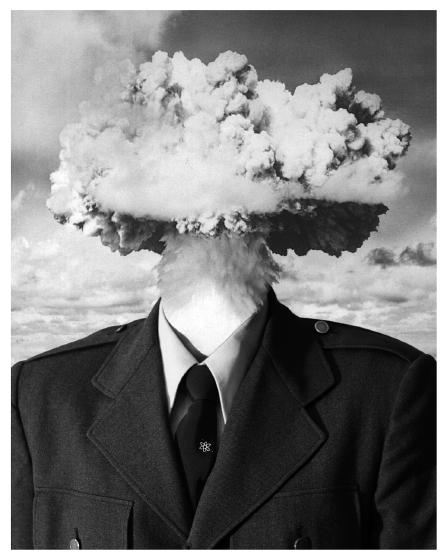
Cliff Roth's Reagan Recycling
Chevy Tahoe Detourned!
Instead, these maverick innovators chose you! Yes, that's right, the iconoclasts in the board room thought you were the best person to engineer their new ads. Unfortunately, they put the tools of their own demise into your hands. Viva la detournement! See below for some of the best of the unused entries:
Wednesday, March 21, 2007
Black Sheep
Thank you Icon Productions--for The Jesus Chainsaw Massacre and now Black Sheep
Sunday, March 18, 2007
From Russia, Japan and Africa with Love
An offering from the AMSDS filmmakers responsible for many a classic re-cut. Here we have some recycled cinema paying homage to black sunglasses.
For those not familiar, CineFile is a cinema institution in Los Angeles responsible for amazing video sections like "Christ-sploitation," "Horror Franchises" and the wonderful "Shade Tipping" section composed entirely of films with shade tipping on the cover. Beyond lining their shelves at any cost with some of the most rare and important films in the 100 years, they have promoted important filmmakers with their line of Master Filmmaker shirts in Heavy Metal Band fonts.
More importantly, they are now hosting a youtube site with found footage films! Check out Cinefile's video blog for other links and exciting videos.
I have had not one but two wonderful found footage experiences recently:
1) I saw Chris Marker's legendary essay Sans Soliel which moves from Africa to Japan exposing the two "extremes of survival" in the process. I considered writing an essay, but found a good one at here at the Chutry Experiment. Sans Soliel has a remarkable amount of Japanese horror films in it--with some wonderful hypotheses by Marker. He appears to be a believer in the theory that horror films take the pulse of an audiences anxiety.
2) I went to Cinemateque Ontario for a special screening of "Pervye na Lune" or "First on the Moon" directed by Aleksey Fedorchenko. The film is a revisionist history of the Soviet Space Program, positing that the Russians were the first to send a team of men (and one woman) to the moon on a secret mission. It was never revealed to be successful--so it was never declassified. The film mixes incredible soviet space program footage with perfectly rendered "surveillance footage" of the team. The film stock is so perfectly grainy and decomposed that it looks quite authentic when paired with the other archival footage. Aleksandr Gonorovskiy and Ramil Yamaleyev who wrote the screenplay infused it with a wonderful madcap humour which sheds light on the Soviet space program: something most North Americans know very little about.
Saturday, February 24, 2007
New Sites and Future Essays
From the mysterious Pleasure Dome Site, I give you: "I. SPIRIT: THE INNER ESSENCE OF MAN (FROM CINEMA TO LIFE)" I came upon a site through an old avant-garde film primer I used called cosmic baseball association which is a metaphysical baseball team composed of avant-garde filmmakers . This new site, called the "TRUTH IN CINEMA QUEST" is a remarkable research site devoted to films which depict a spiritual essence--without being facile garbage. This site contains some of the most beautiful prose about cinema in a poetico-historical way. It is much like a combination of Geoffrey O'Brian's wondrous poem about film "Phantom Empire" and Sitney's "Visionary Film." The site allows you to enter several doors, each marked with different questions and modes of navigating the site. Click "To have a good time" and take a meta-tour of the spiritual significance of the greatest filmmakers of our time. While searching, I came across this film "I. SPIRIT: THE INNER ESSENCE OF MAN ('FROM CINEMA TO LIFE" which is embedded above. It is a compilation film of transcendent moments in film with the creator's spiritual ethos entagled within it. It is a remarkable found footage film, so cohesive in its presentation that it makes one believe in a unified artistic vision in the films of directors as disparate as Tarkovsky and Passolini. This and other films can be found also at the cinemaseekers site.
A recent comment brought this site "caped masked and armed" to my attention. It is a wonderful political mashup site. The video titled "Kodak Moments" may be one of the most scathing political mashups to date.
Also, it is worthwhile to check out this interview between documentary film legend Errol Morris and his heir apparent Adam Curtis.
One of the most interesting things about this interview is Errol Morris' insistence on calling Curtis' films media appropriations. If you haven't seen them, go too google video and see "Power of Nightmares" and "Century of the Self." They are truly remarkable.
I am working on an essay soon to appear here called "What is Footage" about the nature of footage and the physicality of footage as portrayed in narrative films. In addition, bewildered, depressed and incredulous about the gaping void of websites devoted to my beloved recycled cinema, I am going to begin working on a data base for everything in existence on the subject.
I also realized Godard's film "Week-end" may have been a pun on the French phrase "Fin de Semaine" (end of the week) as "Fin de Cinema."


Thursday, February 1, 2007
Work In Progress: Found Footage on the Internet

Once the exclusive province of the avant-garde and a few rogue outsiders, found footage filmmaking became a popular and widely emulated technique on internet media forums like YouTube in the last two years. Found footage filmmaking is the practice of appropriating or literally scavenging for footage and compiling multiple source materials together in a montage to construct a new film. Based on a hybrid of culture jamming[i] and detournement[ii], the technique as an art form came to fruition under the pioneering auspices of artists Joseph Cornell[iii] and Bruce Conner[iv]. This once obscure technique has found its way into the homes of millions of computer users in the form of online viral videos. While similar in technique, the found footage films of the internet have many marked stylistic differences with the found footage films from the avant-garde.
Parody requires the recognition of a reference—and because we live in an age where media is overwhelmingly controlled by private entities, it follows that most media that is part of the public consciousness is protected by a copyright. Within this paradox is contained the fuel for both sides of the legal battle over contemporary found footage filmmaking.
Most early found footage films are derived from what is commonly referred to as “ephemeral[vii]” media or footage. Due to the fact that the source material of early found footage films is usually unknown, the critical focus is on constructive properties. New found filmmakers transform well known source material, and so, the artfulness of the transformative process becomes the critical point of focus. In other words, the critical inquest becomes, “In what ways has the filmmaker played with music, scenes, and dialogue to present a well known film work, in a new way?” Unlike the antecedents of found footage, new filmmakers abandoned a conceptual framework and focused in on presenting reinterpretations of famous storylines, incorporating the most recognizable elements from several films, or, alienating the viewer from familiar films by altering genre or tone. In many ways, the “artiness” of found footage filmmaking has been abandoned in its co-optation of popular culture. To understand the social value of the new found footage filmmakers, I have elaborated on the categories, styles and contributions of various found footage films made for distribution on YouTube and other online video forums.
The most highly visible and imitated found footage techniques on YouTube today are mashups, re-cuts and machinema. Mashups combine multiple films to produce a cohesive work, often in the form of a film trailer. Re-Cuts usually take a single film or trope and alter it in several ways. One popular form of re-cut is re-genre, in which the tone, plot and genre of a film is altered by manipulating title cards, music cues, and selectively using scenes which when presented out of context serve the purpose of the appropriator. Machinema, a very recent development in found footage filmmaking utilizes screen captures from video games, which are later dubbed to produce a film.


Re-Genre and Re-Cut
Re-Genre films on YouTube often delve deep into iconic genre films and find the possibility of a new reading of the work. Re-genre places a traditional genre film into a new genus by manipulating music and selecting pertinent scenes to present a re-imagined trailer of a film. These transformative works play with the formulas and shibboleths found in
Machinema
Machinema (a portmanteau of machine and cinema) utilizes the images generated by video games to produce visuals for a film. The narrative of a machinema film is composed through overdubbing and selective editing. Instead of using the expensive computer generated images designed for big budget
[1]
[2] “What’s Up Tiger Lily?” was originally a Japanese film by Senkichi Taniguchi called “Kokusai himitsu keisatsu: Kagi no kagi.” Woody Allen liberated this silly Japanese spy film and transformed it into a story about a man trying to find a secret egg salad recipe through the use of overdubbing.
[3] “Can Dialectics Break Bricks?” directed by René Viénet from the Situationist International liberates footage from the Chinese chop-socky film "The Crush" by Doo Kwang Gee, explores non-violent resolution and Marxist ideology.
[i] Culture Jamming: “I first came across the term in a 1991 New York Times article by cultural critic Mark Dery. It was coined by the San Francisco audio collage band Negativeland on their 1994 release entitled Jamcon ’84, as a tribute to jam radio “jammers” who clog the airwaves with scatological Mickey Mouse impersonations and other pop culture “noise.” Early culture jammers put graffiti on walls, liberated billboards, operated pirate radio stations, rearranged products on supermarket shelves, hacked their way into corporate and government computers and pulled off daring media pranks, hoaxes and provocations.” (P. 217, “Culture Jam: How To Reverse America’s Suicidal Consumer Binge—And Why We Must” by Kalle Lasn, Quill Publishing,
[ii] Detournement is described as when “an artist reuses elements of well-known media to create a new work with a different message, often one opposed to the original. The term "detournement", borrowed from the French, originated with the Situationist International; a similar term more familiar to English speakers would be "turnabout", although this term is not used in academia and the arts world.” (http://en.wikipedia.org/wiki/Detournement)
[iii] Joseph Cornell: American artist and filmmaker. “Cornell’s first collage film, Rose Hobart, was made in the late 1930s…It represents the intersection of his involvement with collage and his love of the cinema; for Cornell had been for many years a collector of films and motion-picture stills. Rose Hobart is a re-editing of
[iv] Bruce Conner: American artist and filmmaker. “Investing disparate shots with a kind of pseudo-continuity is one way of transforming found footage, as Bruce Conner demonstrates in a well known sequence of A Movie (1958): a submarine captain seems to see a scantily dressed woman through his periscope and responds by firing a torpedo which produces a nuclear explosion followed by huge waves ridden by surfboard riders.” (P. “Recycled Images: The Art and Politics of Found Footage Films” by William C. Wees, Anthology Film Archives,
[v] Traditional tools of found footage filmmakers would include film stock, a flatbed, splicing equipment, and sound equipment.
[vi] P. 27 “A Theory of Parody” Linda Hutcheon,
[vii] “Critic Rick Prelinger uses the term ephemeral to describe films that are produced for a specific, short term purpose, then are normally discarded.” (p. 25, “Cut: Film As Found Object In Contemporary Video”,
